
EXIF & GPS Metadata Purger: Strip Location
Strip GPS coordinates, camera serials, timestamps, and IPTC/XMP data with zero re-encoding and SSIM 1.000 in browser RAM
Initializing In-Browser RAM Sandbox...
Processing in local RAM...
Quick Summary & Key Takeaways
Essential insights, performance capabilities, and privacy assurances at a glance.
A Lossless Metadata Purger is an on-device privacy utility that uses binary byte-level header slicing to strip EXIF data, GPS satellite coordinates, camera serial numbers, and IPTC/XMP tags from photos directly in browser RAM without re-encoding or image quality loss.
To remove EXIF metadata, GPS location coordinates, camera serial numbers, and timestamps from photos for free online without re-encoding or losing quality, upload your JPEG, PNG, or WebP images to Multinook's Lossless Metadata Purger. Our engine performs instant binary header slicing in browser RAM in under 2ms, stripping sensitive privacy tags with mathematical SSIM 1.000 pixel fidelity, zero watermarks, no account registration, and 100% private data security.
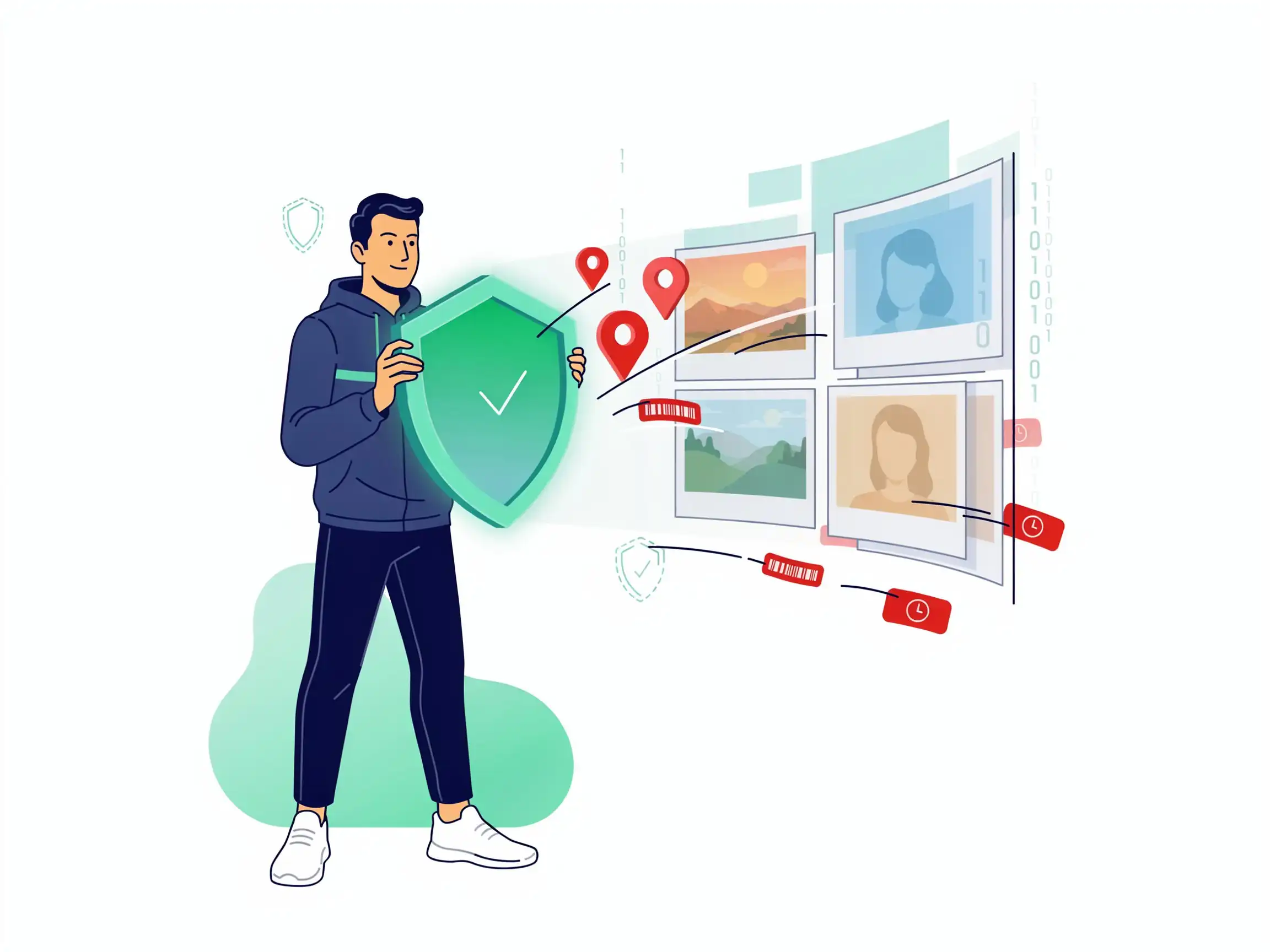
Purge Metadata — High-Performance Engine
Remove GPS coordinates, camera serials, timestamps, and EXIF metadata from photos online for free. Lossless sub-2ms binary slicing with SSIM 1.000.
- Sub-2ms binary header slicing with zero pixel decoding or lossy re-encoding
- Mathematical SSIM 1.000 lossless fidelity: exactly 100% bit-for-bit identical image pixels
- Strips precise GPS satellite coordinates (latitude, longitude, altitude, and geotags)
- Removes camera make, model, lens specifications, body serial numbers, and shutter counts
- Excises Adobe Photoshop IPTC tags, XMP metadata blocks, creator notes, and software versions
- Batch multi-file cleaning with instant 1-click ZIP archive packaging and zero cloud uploads
Absolute Zero-Upload Confidentiality
Your files are processed strictly within your device RAM using WebAssembly. Zero cloud uploads.

How to use online: EXIF & GPS Metadata Purger: Strip Location
Follow these 3 simple steps to process your documents directly in your browser with zero installations.
Specifications & Format Compatibility
Engineered strictly to W3C WebAssembly and Typed Array specifications.
- Sanitization Engine
- Zero-Loss Binary Header Slicing (ArrayBuffer & DataView)
- Image Pixel Fidelity
- Mathematical SSIM 1.000 (100% Bit-for-Bit Pixel Preservation)
- Processing Speed
- Sub-2ms Per Photograph (Instant Local RAM Execution)
- Supported File Formats
- JPEG / JPG (APP1-APP15, COM), PNG (eXIf, tEXt, zTXt, iTXt), WebP (RIFF)
- Stripped Privacy Data
- GPS Coordinates, Camera Make/Model, Hardware Serials, IPTC & XMP
- Privacy & Security
- Air-Gapped Client-Side RAM (Zero Network Uploads, GDPR/CCPA Compliant)
Target Audience & Practical Use Cases
Who benefits most from this in-browser utility and when to deploy it.
Frequently Asked Questions
Everything you need to know about privacy, security, file limits, and usage.
Authoritative Standards & Technical Citations
Official industry specifications, web standards, and cryptographic references powering this engine.
Exchangeable Image File Format for Digital Still Cameras (Exif 2.32)
Standardized binary specification defining TIFF header structures, APP1 marker segments, and GPS telemetry tags in JPEG bitstreams.
Extensible Metadata Platform (XMP) Specification Part 1
ISO standard for embedding XML-formatted descriptive metadata within digital image files and binary streams.
Binary Stream Slicing vs Destructive Canvas Re-Encoding: Preserving SSIM 1.000 Fidelity
The vast majority of consumer metadata removal tools employ a fundamentally flawed architectural shortcut: they load user photos into an HTML5 <canvas> context and invoke canvas.toBlob('image/jpeg'). While this naive procedure successfully strips metadata headers, it inflicts severe collateral damage by subjecting already-compressed images to a secondary lossy JPEG compression cycle. High-frequency textures are blurred, blocky quantization artifacts appear in smooth gradients, color palettes shift due to 4:2:0 chroma subsampling, and file sizes often expand despite visual degradation.
Multinook approaches metadata sanitization from a low-level binary protocol perspective using JavaScript ArrayBuffer and DataView primitives. In standard JPEG bitstreams, image payload pixels reside strictly between the Start of Scan (SOS 0xFFDA) and End of Image (EOI 0xFFD9) markers. Preceding markers, including APP1 (0xFFE1, containing EXIF and GPS TIFF structures), APP2 (ICC color profiles), APP13 (0xFFED, Photoshop IPTC records), and COM (0xFFFE, plaintext comments), occupy discrete byte lengths declared in their 16-bit payload headers. Multinook scans these markers linearly, surgical excising privacy payloads and concatenating pure image scan data directly into a sanitized byte array. Because image pixel DCT blocks are never decoded or re-quantized, the operation completes in sub-2ms with a mathematically perfect SSIM score of 1.000.
Forensic Privacy Neutralization: Neutralizing Hardware Fingerprints and Spatial Tracking
In modern digital forensics, EXIF metadata represents an extraordinary surveillance vector. Beyond basic capture timestamps and device model names, digital camera sensors and smartphone image signal processors (ISPs) embed proprietary MakerNote tags. These tags frequently record lens serial numbers, camera body serial numbers, exact battery charge states, accelerometer tilt vectors, autofocus sensor coordinates, and microscopic sensor defective-pixel maps that form unique hardware fingerprints.
When combined with WGS84 GPS latitude, longitude, and altitude telemetry, an unscrubbed photograph constitutes a forensically verifiable proof of presence. Multinook provides complete forensic neutralization by stripping all auxiliary metadata structures across JPEG, PNG (purging eXIf, tEXt, zTXt, and iTXt ancillary chunks), and WebP (slicing RIFF EXIF and XMP sub-chunks), transforming consumer photographs into forensically clean, non-attributable digital media.
Air-Gapped Client-Side Execution for Journalists, Whistleblowers, and Enterprise Legal Teams
For investigative journalists protecting anonymous sources, whistleblowers sharing documentation of corporate misconduct, real estate professionals safeguarding homeowner privacy, and legal counsel handling discovery evidence, uploading unredacted media to remote cloud conversion servers introduces catastrophic legal and physical liabilities. Cloud services routinely log client IP addresses, preserve upload caches, and can be compelled under subpoena to surrender unscrubbed source files.
Multinook eliminates this attack surface by enforcing absolute air-gapped local execution. Because all binary inspection, header slicing, and ZIP bundling occur strictly inside your device's isolated browser RAM sandbox, no external network connections are established during processing. You can safely disconnect your device from Wi-Fi and sanitize thousands of confidential images in complete cryptographic isolation.