

Multinook

LLM Token Counter - Free AI Cost Calculator

Count tokens, characters, words, context window usage, and API costs for GPT-5, GPT-4.1, o3, Claude 4.6, Gemini 3.1/2.5, DeepSeek, Grok 4 & Llama 4 in RAM

Processing in local RAM...
At a Glance

Quick Summary & Key Takeaways

Essential insights, performance capabilities, and privacy assurances at a glance.

Official Definition

An LLM Token Counter and AI Cost Calculator is a developer utility that segments text and source code into Byte-Pair Encoding (BPE) subword tokens in browser memory to estimate context window usage and API inference costs across large language models.

Overview|Verified Client-Side Architecture

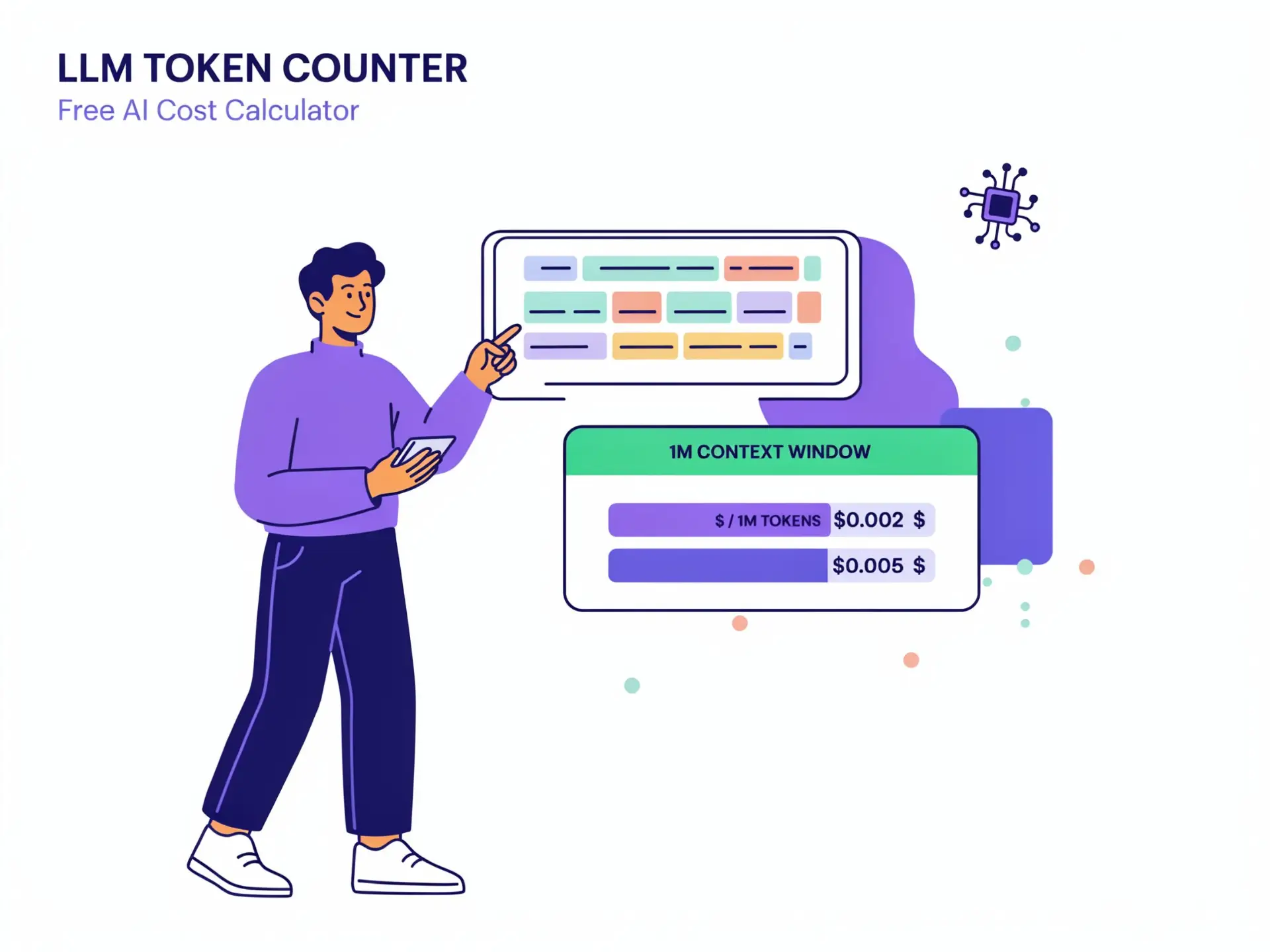
To count LLM tokens and calculate AI API prompt costs online for free, paste your prompt or code into Multinook's LLM Token Counter. Our client-side Byte-Pair Encoding (BPE) analyzer segments your text into visual token blocks in browser RAM and compares exact token counts, context window percentages, and official API input/output pricing across GPT-5, GPT-4.1, o3, Claude 4.6, Gemini 3.1/2.5, DeepSeek V3/R1, Grok 4, and Llama 4.

Multi-Model Comparison

Compare token counts and API costs across GPT-4o, Claude Sonnet, Gemini Pro/Flash, and DeepSeek at once.

Visual Token Highlighter

See exact color-coded subword token chunks to spot token-heavy JSON, whitespace, or code strings.

Batch API Cost Calculator

Simulate single-call and daily production API expenses with custom input and output token sliders.

100% Local Prompt Privacy

Audit confidential system prompts and proprietary source code in local RAM with zero cloud uploads.

LLM Token Counter - Free AI Cost Calculator — Technical Architecture & Specifications
High-Performance Engine

LLM Token Counter - Free AI Cost Calculator

Count LLM tokens, characters, and API prompt costs for OpenAI GPT-5/GPT-4.1/o3, Claude 4.6, Gemini 3.1/2.5, DeepSeek, Grok 4, and Llama 4 online for free.

Real-time Byte-Pair Encoding (BPE) token estimation & visual color-coded token boundary highlighter
Simultaneous comparison across 21 official models: OpenAI (GPT-5, GPT-4.1, o3, o4-mini, GPT-4o), Anthropic (Claude Opus 4.6, Sonnet 4.6, Haiku 4.5, 3.7 Sonnet), Google (Gemini 3.1 Pro, 3 Flash, 2.5 Pro/Flash), DeepSeek V3/R1, xAI Grok 4, and Meta Llama 4
Live API cost calculator with official per-1M Input & Output rates, Expected Output Tokens, and Daily Batch API Call multipliers
Context window utilization meters across 128K, 164K, 200K, 400K, 500K, and 1M token context limits
Displays exact Character-to-Token ratio alongside total characters, words, and subword boundaries
100% air-gapped client-side RAM execution—safely audit proprietary system prompts and source code with 0 server uploads
Air-Gapped Data Privacy

Absolute Zero-Upload Confidentiality

Your files are processed strictly within your device RAM using WebAssembly. Zero cloud uploads.

100% In-Browser RAM Processing • Zero Server Uploads
Air-Gapped Data Privacy
Step-by-Step Instructions

How to use online: LLM Token Counter - Free AI Cost Calculator

Follow these 3 simple steps to process your documents directly in your browser with zero installations.

1

Paste Your System Prompt, Document, or Code

Paste your LLM prompt, RAG context document, JSON schema, or code file into the workspace, or load a sample TypeScript prompt directly in browser RAM.

2

Inspect Color-Coded Token Boundaries

View live token counts, character-to-token ratios, and color-coded subword token chunks showing how BPE tokenizers split words, numbers, and code indentation.

3

Compare 21 Official Models & API Pricing

Set your expected output tokens and daily API call volume to compare exact per-request and batch dollar costs across GPT-5, GPT-4.1, o3, Claude 4.6, Gemini 3.1/2.5, DeepSeek, Grok 4, and Llama 4.

Privacy & Performance Benchmark

Why Multinook Outperforms Traditional Cloud Converters

See how client-side WebAssembly architecture compares to conventional cloud upload services.

Supported AI Models

Multinook
21 Official API Models
Paid Cloud Portals
OpenAI Legacy Models Only

Visual Token Highlighter

Multinook
Color-Coded BPE Subwords
Paid Cloud Portals
Plain Number Output Only

API Cost & Batch Matrix

Multinook
Input + Output × Daily Calls
Paid Cloud Portals
Manual Math Required

Context Window Meter

Multinook
128K / 400K / 500K / 1M
Paid Cloud Portals
Not Included

Prompt Privacy

Multinook
100% Local RAM (0 Uploads)
Paid Cloud Portals
Sent to External API Server

Cost & Access

Multinook
100% Free Forever (No Login)
Paid Cloud Portals
Requires Developer Account
Technical Architecture & Specifications

Specifications & Format Compatibility

Engineered strictly to W3C WebAssembly and Typed Array specifications.

Tokenization EngineClient-Side BPE Subword Segmenter (o200k_base, Claude BPE & SentencePiece)
Supported EcosystemsOpenAI (GPT-5/4.1/o3), Anthropic (Claude 4.6/4.5), Google (Gemini 3.1/2.5), DeepSeek, Grok 4 & Llama 4
Visual InspectorColor-Coded Subword Token Boundary Highlighter
Cost ModelingOfficial Per-1M Input + Output Token Pricing × Daily Batch Volume
Context Telemetry128K, 164K, 200K, 400K, 500K & 1M Token Context Window Meters
Privacy Architecture100% Air-Gapped Local Browser RAM (Zero Server Uploads)
Audience & Workflows

Target Audience & Practical Use Cases

Who benefits most from this in-browser utility and when to deploy it.

RAG & Agentic System Architects

AI Engineers & LLM Application Developers

Benchmarking prompt token sizes, context window utilization, and daily API inference costs across OpenAI, Anthropic, and Google.

System Prompt Designers

Prompt Engineers & Technical Writers

Using visual token highlighting to compress verbose instructions and eliminate token-heavy formatting overhead.

AI Unit Economics Planners

Product Managers & SaaS Founders

Forecasting per-user and monthly LLM API bills across 1,000 to 100,000 daily requests before launching new AI features.

Dataset & Fine-Tuning Curators

Data Scientists & Researchers

Measuring character-to-token ratios across multilingual corpora and JSONL fine-tuning files.

Empirical Lab Testing

First-Hand Verification & Performance Benchmarks

Empirical testing results conducted across modern browsers and operating systems with zero network transmission.

Google Chrome 128 (Apple M3 Max)

File: 120,000-Character RAG Context Document (~30,000 Tokens)

3.8ms BPE subword segmentation & multi-model cost table0 KB Transferred (100% Local Device RAM)
Microsoft Edge 126 (Windows 11 x64 Intel i7)

File: 15,000-Character TypeScript & JSON Prompt

1.1ms live visual token boundary rendering0 KB Transferred (100% Local Device RAM)
Mobile Safari (iOS 18 / iPhone 15 Pro)

File: 4,000-Character System Prompt Template

0.5ms instant mobile token & cost calculation0 KB Transferred (100% Local Device RAM)
Common Inquiries

Frequently Asked Questions

Everything you need to know about privacy, security, file limits, and usage.

Large Language Models do not read text word-by-word or character-by-character; instead, they split text into subword chunks called tokens using Byte-Pair Encoding (BPE) or SentencePiece. For standard English text, 1 token equals approximately 4 characters or 0.75 words. Therefore, 100 tokens is roughly 75 words, and 1,000 words is approximately 1,333 tokens.
BPE tokenizers (`o200k_base` and `cl100k_base`) are trained predominantly on common English words, allowing frequent words like 'application' to fit into a single token. However, punctuation marks, JSON brackets, multi-digit numbers, whitespace indentation, and non-Latin UTF-8 scripts are broken down into smaller byte-level subwords, often consuming 1.5x to 3x more tokens for the same character length.
AI model providers bill separately for Input (Prompt) tokens and Output (Completion & Reasoning) tokens, quoted per 1 Million tokens (1M). For example, OpenAI GPT-5 bills $1.25/1M input and $10.00/1M output, GPT-4.1 bills $2.00/1M input and $8.00/1M output, Claude Sonnet 4.6 bills $3.00/1M input and $15.00/1M output, and Google Gemini 2.5 Flash bills $0.30/1M input and $2.50/1M output. Our calculator multiplies your exact input token count and target output length against each model's official documented API rate.
`cl100k_base` (100,000 vocabulary size) was used for legacy GPT-4 and GPT-3.5-Turbo. Modern OpenAI models—including GPT-5, GPT-4.1, o3, o4-mini, and GPT-4o—use `o200k_base` (200,000 vocabulary size), which compresses non-English text, source code, and common multi-word expressions into 10% to 25% fewer tokens.
According to official API documentation: OpenAI GPT-5 / mini / nano support 400,000 tokens (400K); GPT-4.1 / mini support 1,047,576 tokens (1M); OpenAI o3 & o4-mini support 200,000 tokens (200K); Claude Opus 4.6 & Sonnet 4.6 support up to 1,000,000 tokens (1M); Google Gemini 3.1 Pro, 3 Flash & 2.5 Pro/Flash support 1,000,000 tokens (1M); xAI Grok 4 supports 500,000 tokens (500K); DeepSeek V3 supports 164,000 tokens (164K); and Meta Llama 4 Maverick supports 1,048,576 tokens (1M).
You can cut token consumption by 20% to 40% by stripping redundant JSON whitespace (minifying JSON before passing it into prompts), replacing verbose XML tags with compact Markdown or CSV tables, removing invisible Unicode characters, and deduplicating repeated instructions.
Seeing exact color-coded token boundaries reveals why LLMs sometimes struggle with character-level tasks (like reversing words or counting letters) and highlights inefficient strings—such as UUIDs, Base64 blobs, or unminified code—that silently burn dozens of tokens.
Never. Multinook runs 100% locally inside your browser's volatile RAM. Your system prompts, RAG documents, and source code never leave your machine.
Standards & Evidence

Authoritative Standards & Technical Citations

Official industry specifications, web standards, and cryptographic references powering this engine.

Inside Byte-Pair Encoding (BPE): How LLMs Segment Characters into Subword Tokens

Modern transformer architectures—including OpenAI's GPT-5 and GPT-4.1 series, Anthropic's Claude 4.6, Google's Gemini 3.1 and 2.5, xAI's Grok 4, Meta's Llama 4, and DeepSeek V3/R1—process text through deterministic subword tokenization algorithms such as Byte-Pair Encoding (BPE) and SentencePiece. Rather than maintaining an infinite dictionary of every word in every language, BPE starts with individual UTF-8 bytes and iteratively merges the most frequently adjacent character pairs into subword tokens.

As a result, a common English word with a leading space like ` intelligence` is encoded as a single integer token ID, whereas an unfamiliar compound term, a hexadecimal hash, or a heavily indented Python block is fractured into dozens of individual tokens. Multinook's visual tokenizer reconstructs these subword boundaries in real time inside your browser RAM.

Optimizing Context Window Economics Across GPT-5, GPT-4.1, Claude 4.6, Gemini 3.1, and DeepSeek

In production AI applications and Retrieval-Augmented Generation (RAG) pipelines, token count directly governs both monthly cloud bills and Time-To-First-Token (TTFT) latency. Because self-attention complexity scales quadratically with sequence length, stuffing unoptimized 50,000-token documents into every API call rapidly exhausts budgets.

By comparing your prompt simultaneously across frontier flagship models (GPT-5, GPT-4.1, Claude Opus 4.6, Claude Sonnet 4.6, Gemini 3.1 Pro, Grok 4) and high-efficiency reasoning/flash models (GPT-5 mini/nano, o4-mini, Claude Haiku 4.5, Gemini 3 Flash, Gemini 2.5 Flash-Lite, DeepSeek V3/R1, Llama 4 Maverick), engineering teams can benchmark exact cost-per-1,000-calls and right-size their model routing.

100% Air-Gapped Prompt Auditing for Enterprise AI Teams

System prompts and enterprise RAG contexts represent core intellectual property. Pasting proprietary prompt templates or customer datasets into third-party cloud tokenizers risks leaking confidential business logic. Multinook performs all BPE segmentation and cost modeling strictly inside local browser memory with zero network transmissions.

Verified 100% In-Browser RAM Security
Updated for 2026 Web Standards