
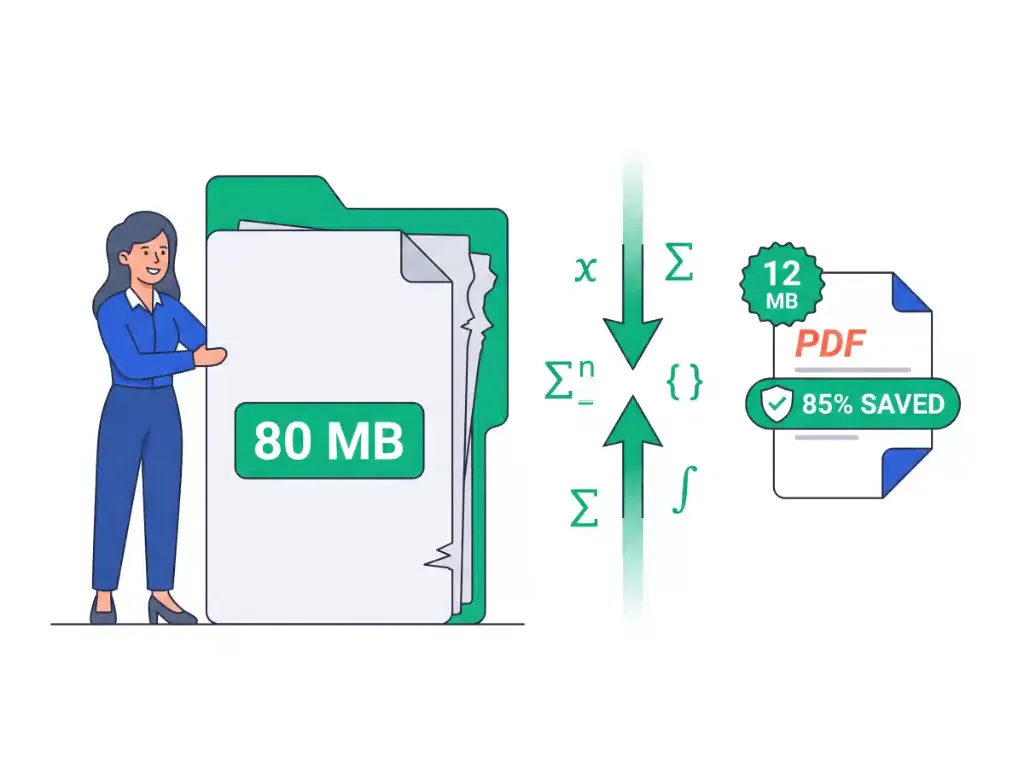

The Engineering Behind In-Browser PDF Compression
Traditional online compressors upload multi-megabyte PDF documents to remote cloud server farms, introduce queuing latency, and often rely on lossy server scripts like Ghostscript that rasterize vector text into blurry, pixelated bitmaps. This legacy workflow creates severe privacy risks for confidential financial reports, contracts, and medical records.
Our Dual-Pass compression engine operates entirely within your browser's isolated WebAssembly runtime. In Pass 1, the engine inspects the PDF Cross-Reference (xref) table, prunes unreferenced dead revisions, removes non-essential TrueType hinting tables (such as hdmx, VDMX, LTSH, and PCLT), and deflates raw object streams (/ObjStm) without touching text glyph vectors.
When deeper reduction is required, Pass 2 evaluates embedded raster images. Using MozJPEG-grade discrete cosine transform (DCT) quantization, embedded photographs are downsampled to calibrated DPI targets (96 to 150 DPI) and re-embedded into exact physical page bounds. Because all calculations run in your device RAM via Web Workers, your documents remain 100% private with sub-second execution speeds.