
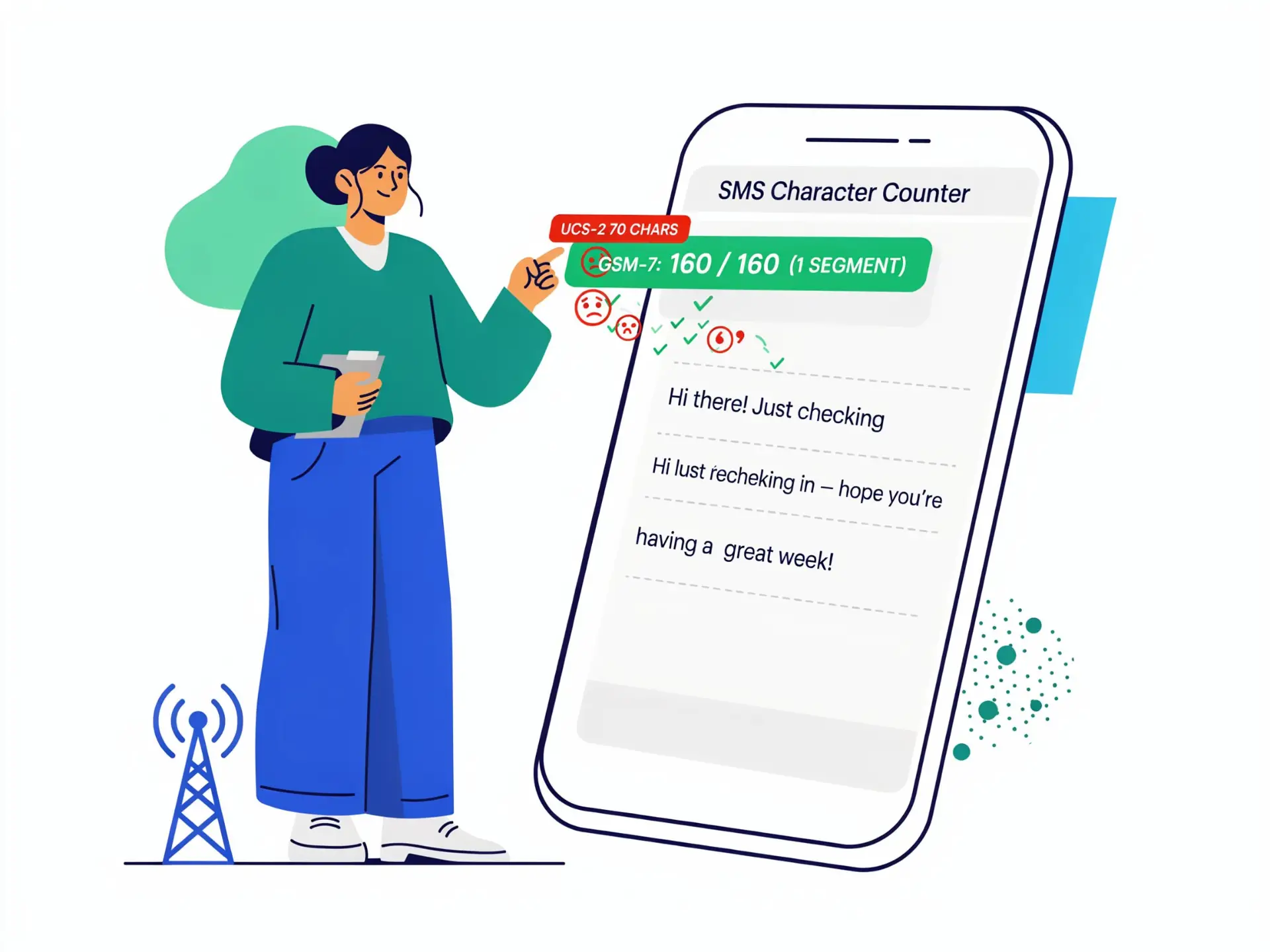

The 140-Byte Telecom Payload: Understanding GSM 03.38 (GSM-7) vs. UCS-2 Encoding
Every standard Short Message Service (SMS) frame transmitted across cellular signaling channels is strictly capped at 1,120 bits (140 octets/bytes). Under the 3GPP TS 23.038 specification, when a message uses only characters from the 128-character GSM-7 default and extension alphabets, each character is packed using 7 bits (a septet). Dividing 1,120 bits by 7 bits per septet yields the famous 160-character SMS limit ($1120 / 7 = 160$).
However, the moment a message includes a character outside the GSM-7 character set—such as a Cyrillic, Arabic, Hindi, or Chinese glyph, an emoji, or a typographic curly quote (`U+2019`)—the SMS gateway must re-encode the entire payload using UCS-2 (16 bits / 2 bytes per code unit). Dividing 1,120 bits by 16 bits immediately slashes the single-message capacity to 70 characters.